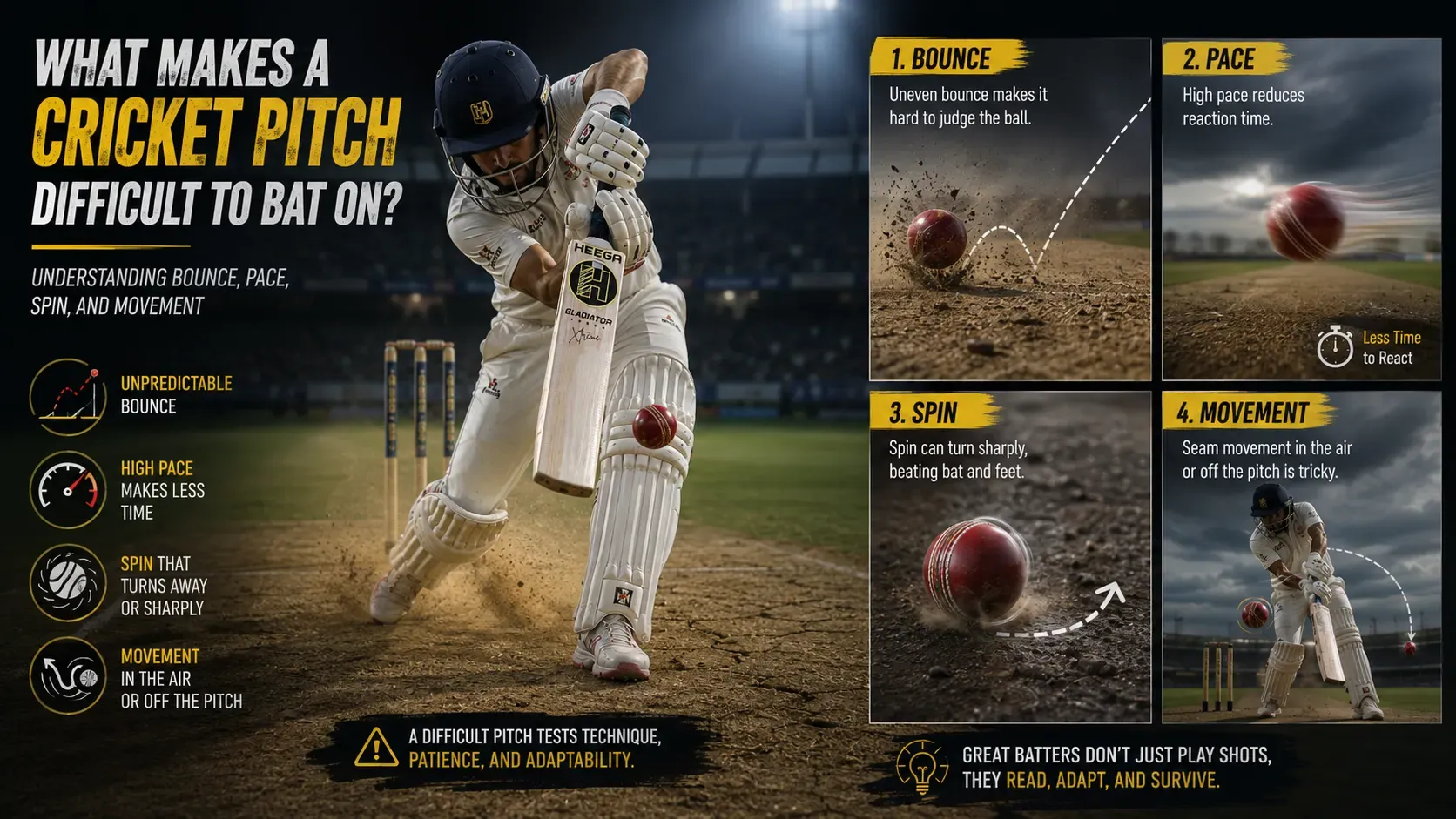
What Makes a Cricket Pitch Difficult to Bat On? Understanding Bounce, Pace, Spin, and Movement
Introduction: Why Is Batting Easier on Some Pitches Than Others?
A cricket batter can have excellent technique and still struggle when the playing surface becomes difficult.
The reason is simple: the ball does not behave exactly the same on every cricket pitch.
Some pitches are hard and fast.
Others are slow and low.
Some provide significant seam movement.
Others help spinners.
A few can change dramatically as a match progresses.
For batters, these differences can affect:
- Timing
- Footwork
- Shot selection
- Balance
- Confidence
- Decision-making
- Scoring opportunities
A pitch does not need to look dangerous to be difficult.
Sometimes the biggest challenge is uncertainty.
A batter may expect the ball to bounce one way and receive something completely different.
Understanding why this happens can help players appreciate one of the most important aspects of cricket: reading the pitch and adapting to it.
What Is a Cricket Pitch?
The cricket pitch is the central playing area where most deliveries are bowled and played.
It is traditionally 22 yards long, with the bowling creases and popping creases marking important positions.
The surface is prepared to provide a playable contest between batters and bowlers.
However, its behavior can vary significantly.
Why Pitch Conditions Matter
The ball interacts with the surface after being delivered.
That interaction determines how the ball behaves.
The pitch can influence:
- Bounce
- Speed
- Seam movement
- Spin
- Ball grip
- Shot timing
This is why two matches played with similar players can feel completely different when the pitches are different.
Hard Pitches Can Produce Faster Conditions
A firm surface can allow the ball to travel quickly after pitching.
Fast bowlers may receive additional assistance from the pace of the surface.
For batters, this can create both opportunities and challenges.
Why Pace Can Help Batters Too
A fast pitch is not automatically a bad pitch for batting.
If the bounce is consistent, batters can use the ball's speed to score quickly.
The problem begins when pace is combined with uncertainty.
Uneven Bounce Creates Difficulty
One of the biggest challenges for batters is inconsistent bounce.
A delivery may bounce higher than expected.
Another may stay lower.
This makes shot selection much harder.
Why Inconsistent Bounce Is Dangerous
Batting depends heavily on predicting where the ball will arrive.
If the bounce changes unexpectedly, the batter may:
- Miss the ball
- Edge it
- Mistime a shot
- Get hit
- Lose balance
Low-Bouncing Pitches Create Different Problems
A pitch that produces low bounce can make traditional batting strokes difficult.
Batters may have less room to get underneath the ball.
Why Full-Length Shots Can Become Difficult
If the ball stays unusually low, the batter may struggle to get the bat into the ideal position.
Timing becomes extremely important.
Slow Pitches Can Reduce Batting Tempo
A slow pitch can make the ball arrive later than expected.
This creates a completely different challenge from a fast surface.
Why Batters Often Mis-Time Shots on Slow Pitches
The batter may expect the ball to arrive at a certain speed.
They commit to the shot.
But the ball takes longer to reach them.
The result can be:
- Mistimed drives
- Catches
- Weak pulls
- Mis-hits
Pace-Off Conditions Reward Patience
On a slower pitch, batters often need to wait longer for the ball.
Trying to hit every delivery too early can create problems.
Spin Can Become a Major Threat
Some pitches provide more assistance to spin bowlers.
This can happen because of surface characteristics, wear, dryness, or moisture.
Why Spinners Like Certain Surfaces
A spinner benefits when the pitch allows the ball to:
- Grip
- Turn
- Bounce differently
- Change pace after pitching
Turn Makes Shot Selection Difficult
A batter may read the line correctly but still misjudge where the ball will finish.
This is especially challenging against high-quality spinners.
The Role of Surface Friction
Spin depends partly on how the ball interacts with the surface.
A rough or dry area can provide more grip.
Why Dry Pitches Can Assist Spin
As a surface dries and wears, certain areas may become more responsive to spin.
This can make the ball turn more sharply.
Rough Areas Can Become Important Later in a Match
As bowlers repeatedly land the ball in the same areas, the pitch can develop worn patches.
Spinners may target these areas.
Footmarks Can Influence Spin
Bowling footmarks created during a match can become relevant.
Spinners may use these rough areas to create additional variation.
Seam Movement Creates Another Challenge
A pitch can also help seam bowlers.
If the ball lands correctly, the seam can interact with the surface and change the ball's direction.
Why Seam Movement Is Difficult to Predict
The batter may initially read the delivery correctly.
Then the ball moves after pitching.
Even a small deviation can create an edge.
Green Surfaces Can Encourage Seam
A pitch with visible grass may sometimes offer more assistance to seam bowling, particularly when combined with suitable atmospheric conditions.
However, grass alone does not determine how a pitch will behave.
Moisture Can Change the Surface
Water content in the pitch can influence how the ball behaves.
The exact effect depends on the surface and weather.
Why Moisture Can Affect Bowling
Moisture can influence:
- Ball grip
- Seam movement
- Pitch firmness
- Ball speed
Morning Conditions Can Be Different
In some matches, early conditions can differ from those later in the day.
This is why teams carefully observe the pitch before and during a match.
Weather and Pitch Conditions Work Together
The pitch does not exist separately from the environment.
Weather can influence the playing surface.
Important factors include:
- Temperature
- Humidity
- Rain
- Sunlight
- Wind
Rain Can Transform a Pitch
Rain can alter the moisture content of the surface.
After the pitch dries, its behavior may change again.
Why Drying Conditions Matter
A surface may begin with moisture and gradually become firmer.
The way it changes can influence both bowling and batting.
Cracks Can Appear on Some Pitches
As pitches dry and wear, cracks may develop.
These cracks can sometimes create unpredictable bounce or movement.
Why Cracks Matter to Batters
If the ball lands near an uneven area, it may behave differently from a delivery landing on a smoother section.
This adds uncertainty.
Not Every Crack Makes a Pitch Dangerous
The appearance of cracks does not automatically mean a pitch is unplayable.
Their location, depth, and effect on bounce are what matter.
Pitch Wear Increases Over Time
A pitch can behave differently on different days of a Test match.
This is one of the fascinating aspects of long-format cricket.
Day One and Day Five Can Be Very Different
Early in a match, the surface may be relatively fresh.
Later, it may have:
- Footmarks
- Rough patches
- Cracks
- Uneven areas
These changes can influence bowling and batting.
Why Test Batting Requires Adaptability
A batter cannot assume that conditions will remain identical throughout a long innings.
They must continuously reassess the surface.
Reading the Pitch Before Batting
Experienced batters often observe the pitch before facing their first delivery.
They may look at:
- Grass coverage
- Cracks
- Dry patches
- Footmarks
- Surface hardness
Why Visual Observation Helps
A batter cannot control the pitch.
But they can prepare mentally for what it might do.
Watching the First Few Balls Is Important
The opening deliveries can provide valuable information.
The batter can observe:
- Bounce
- Speed
- Movement
- Carry to the wicketkeeper
Why Early Information Matters
The batter can use those observations to adjust their approach.
Good Batters Test the Conditions
Rather than immediately attempting high-risk shots, a batter may initially play controlled strokes.
This helps them understand the pitch.
Timing Becomes More Important Than Power
When conditions are difficult, hitting harder is not always the answer.
Clean contact matters more.
Why Hard Hands Can Cause Problems
If the batter attacks the ball with rigid hands, movement off the pitch can produce edges.
Soft hands can sometimes help control the outcome of defensive shots.
Footwork Becomes Critical
Difficult pitches reward disciplined footwork.
Batters need to move decisively.
Why Half-Forward Footwork Can Be Risky
If the batter is neither fully forward nor comfortably back, they may become trapped between options.
This can make unpredictable bounce even more dangerous.
Moving Forward Against Spin
When appropriate, coming down the pitch can reduce the amount of turn available to the spinner.
But the decision must be made carefully.
Staying Back Can Also Be Useful
Against some deliveries, remaining deep in the crease can provide additional time.
The correct option depends on the length and conditions.
Why There Is No Single Footwork Rule
Good batting is about responding to the actual delivery.
Players should not blindly follow a fixed movement pattern.
Shot Selection Changes on Difficult Pitches
A batter may choose different shots depending on conditions.
They may prioritize:
- Straight batting
- Ground shots
- Controlled singles
- Defensive strokes
instead of constant boundary hitting.
Why Lofted Shots Can Become Riskier
If bounce and pace are unpredictable, mistiming a lofted shot can create an easy catch.
Ground Shots Can Offer Greater Control
Keeping the ball along the ground can reduce some of the risks associated with uncertain bounce.
But Defensive Batting Is Not Always Enough
A batter still needs to score.
If they become excessively defensive, bowlers can build pressure.
The Best Approach Is Controlled Aggression
A batter should identify deliveries that can be attacked while respecting those that deserve caution.
Match Situation Changes the Strategy
A batter defending a Test match may take a different approach from a batter chasing a large T20 target.
Required Run Rate Matters
In limited-overs cricket, the scoring requirement can force batters to take risks even on difficult surfaces.
Why Difficult Pitches Increase Pressure
When scoring becomes harder, every mistake becomes more significant.
Dot balls can accumulate.
Wickets become more valuable.
Bowlers Can Exploit Pitch Conditions
A good bowler studies the surface and targets areas where it provides assistance.
Fast Bowlers Look for Movement and Bounce
They may target:
- Off-stump channels
- Short lengths
- Full swing deliveries
- Body-line areas
depending on the pitch.
Spinners Search for Grip and Turn
They may repeatedly land the ball in areas where the surface offers assistance.
Why Consistency Is Powerful
A bowler does not need a different trick every delivery.
Consistently hitting the right area can allow the pitch to do the work.
The Importance of Seam Position
A stable seam can help a bowler maximize movement from the surface.
Why Bowlers Target the Same Area
If one part of the pitch provides extra assistance, bowlers may repeatedly use it.
Batters Must Identify the Pattern
If a bowler keeps targeting the same difficult area, the batter needs to develop a response.
The Role of the Wicketkeeper
The wicketkeeper can provide valuable information about:
- Bounce
- Carry
- Movement
- Pace
This can help the bowling team adjust.
Captains Study the Pitch Too
The captain needs to understand how the surface is behaving.
They may change:
- Field placements
- Bowling changes
- Spin usage
- Pace bowling plans
Why Field Placement Changes on Difficult Pitches
When batting becomes difficult, fielders can be placed closer to catching positions.
A captain may attack rather than simply defend boundaries.
Catchers Become More Valuable
If the pitch is creating edges or mis-hits, close fielders can become important.
Technology Helps Analyze Pitch Behavior
Modern cricket increasingly uses technology to understand performance.
Teams can use:
- Video analysis
- Ball tracking
- Performance data
- Pitch mapping
- Weather information
Ball Tracking Can Show Bounce Patterns
Data can help teams understand where deliveries are pitching and how they behave.
Video Analysis Reveals Batting Errors
A batter may think they are struggling because the pitch is difficult.
Video can reveal whether technical mistakes are making the conditions even harder.
Why Data Does Not Replace Observation
Statistics provide information.
Players still need to observe what is happening in real time.
Different Formats Create Different Pitch Challenges
The same type of surface can have different effects depending on the format.
Test Cricket
Long-format cricket allows the pitch to evolve.
Changes over multiple days can become a major part of the strategy.
ODI Cricket
One-day cricket requires teams to balance risk and scoring.
A difficult surface can make middle overs particularly tactical.
T20 Cricket
T20 cricket gives players less time to adapt.
Batters may have to score quickly despite difficult conditions.
Why T20 Batting Can Be Challenging on Slow Pitches
A batter cannot simply wait indefinitely.
The required run rate may force attacking shots.
The Role of the Toss
Pitch conditions can influence the decision at the toss.
Captains may consider:
- Current surface
- Weather forecast
- Dew
- Expected pitch deterioration
- Chasing conditions
Why Toss Decisions Are Not Simple
A pitch that looks difficult now may become easier later.
Another surface may become harder as it wears.
Captains need to think ahead.
Difficult Pitches Can Reveal Better Batters
When conditions are perfect, many players can score quickly.
Difficult pitches separate players who can adapt.
Adaptability Is a Major Batting Skill
A good batter can change their approach without losing technical control.
Why Patience Matters
The batter may need to wait for scoring opportunities.
Not every ball needs to be attacked.
Mental Strength Becomes Important
Difficult pitches can create frustration.
The batter may play several deliveries without scoring.
Staying composed is critical.
Avoiding Panic Is Part of the Challenge
A batter who becomes desperate may attempt an unnecessary shot.
That can give the bowler exactly the opportunity they want.
Learning From Previous Deliveries
Each ball provides information.
A batter can ask:
- How high did it bounce?
- How quickly did it arrive?
- Did it move?
- Did it turn?
- Was the pitch slower than expected?
Why Experienced Players Adapt Quickly
They have encountered more conditions throughout their careers.
Their previous experiences create useful reference points.
Young Players Can Learn This Skill
Young cricketers should be encouraged to observe the pitch rather than simply start hitting.
Coaches can ask them to describe:
- Bounce
- Pace
- Movement
- Ball behavior
Practice on Different Surfaces Helps
Players who train only on one type of surface may struggle when conditions change.
Exposure to different pitches improves adaptability.
Practice Nets Can Simulate Different Challenges
Coaches can vary:
- Bowling speed
- Length
- Spin
- Bounce
- Ball type
This helps players develop responses to different conditions.
The Importance of Quality Cricket Equipment
Difficult conditions make proper equipment even more important.
Players need reliable gear that allows them to focus on technique.
Useful equipment includes:
- Cricket bats
- Leather cricket balls
- Practice balls
- Batting gloves
- Batting pads
- Helmets
- Practice nets
- Training accessories
How Heega Sports Supports Players in Every Condition
At Heega Sports, we understand that players need dependable equipment to train across different playing environments.
Our cricket range includes:
- Kashmir Willow cricket bats
- English Willow cricket bats
- Leather cricket balls
- Practice balls
- Batting gloves
- Batting pads
- Cricket helmets
- Cricket shoes
- Cricket kit bags
- Practice nets
- Training accessories
The right equipment helps players focus on developing technique, confidence, and adaptability.
Cricket Pitches Around the World
Pitch behavior can vary significantly between cricket-playing regions, including Nepal, Germany, the United States, Canada, the Netherlands, and the United Kingdom.
Nepal
Players can encounter different pitch conditions across domestic and club cricket.
Learning to adapt to changing bounce and pace can be particularly valuable.
Germany
As cricket develops across Germany, players may experience a variety of playing surfaces and weather conditions.
Adaptability can help players transition between different environments.
United States
The growing cricket landscape in the USA includes a wide range of grounds and climates.
Players may need to adjust their techniques accordingly.
Canada
Seasonal conditions create different playing environments throughout the year.
Indoor training can help players maintain technical development when outdoor cricket is limited.
Netherlands
Cooler and sometimes humid conditions can influence how pitches and outfields behave.
Players benefit from learning how environmental conditions affect the ball.
United Kingdom
British cricket provides players with exposure to a wide range of pitch types and weather conditions.
Learning to adapt to movement and changing surfaces is an important part of development.
How to Become a Better Batter on Difficult Pitches
Players can follow a simple process.
1. Watch the Pitch
Observe the surface before batting.
2. Study the First Deliveries
Use the opening balls to understand bounce and pace.
3. Stay Balanced
Avoid excessive movement until the ball is understood.
4. Watch the Release
Track the bowler carefully.
5. Play Straight When Appropriate
Controlled batting can reduce unnecessary risk.
6. Respect Good Deliveries
Not every ball needs to be scored from.
7. Attack the Right Balls
Identify deliveries that offer genuine scoring opportunities.
8. Adapt Continuously
Pitch conditions can change during an innings.
Why Difficult Pitches Make Cricket More Interesting
Perfect batting conditions can produce spectacular scores.
But challenging pitches test a different set of skills.
They reward:
- Patience
- Technique
- Concentration
- Adaptability
- Shot selection
- Mental strength
Final Thoughts
A cricket pitch can completely change the way a match is played.
The same batter can look unstoppable on one surface and uncomfortable on another.
The difference may come from:
- Pace
- Bounce
- Seam movement
- Spin
- Moisture
- Wear
- Cracks
- Weather
- Outfield conditions
The best players understand that they cannot control the pitch.
They can only control how they respond to it.
A batter who studies the surface, watches the first few deliveries carefully, maintains balance, chooses appropriate shots, and remains patient can often succeed even when conditions are difficult.
That is one of the most valuable lessons in cricket.
Great batting is not about expecting every pitch to behave perfectly. It is about learning how to perform when it does not.
🏏 Prepare for Every Pitch With Heega Sports
Explore quality cricket bats, leather balls, practice balls, batting gloves, pads, helmets, cricket shoes, kit bags, practice nets, and training accessories at Heega Sports.
Shop Now
Heega Sports – Helping Players Adapt, Perform, and Improve on Every Cricket Surface.
Related posts
 How Kids Learn to Read a Cricket Ball: Understanding Line, Length, Bounce and Shot SelectionLearn how kids can read a cricket ball by understanding line, length, bounce and shot selection to develop better batting skills and confidence.
 Cricket Shoes Explained: How Stud Patterns, Grip and Sole Design Affect Performance on Different PitchesLearn how cricket shoes, stud patterns, grip and sole design affect traction, stability, comfort and performance on grass, turf and artificial pitches.
 Wicket Keeping Leg Guards Explained: Fit, Flexibility and Protection for Faster Movement Behind the StumpsDiscover how to choose wicketkeeping leg guards with the right fit, flexibility, and protection for quicker movement, comfortable crouching, and confident keeping.