Why Cricket Bat Sweet Spots Matter: How Contact Position Changes Power and Timing
Introduction: Why Does the Sweet Spot Matter So Much?
A cricket bat can look perfect in the hands of a player, but its performance depends on much more than appearance.
One of the most important areas of a cricket bat is its sweet spot.
This is the part of the blade where clean contact can produce an efficient transfer of energy while generally creating a comfortable feel in the hands.
When a batter connects with the ball in this area, the shot can feel noticeably different.
The bat may feel stable.
The ball can leave the blade quickly.
There may be less unpleasant vibration.
The shot can also require less effort to produce a strong result.
However, hitting the sweet spot does not automatically guarantee a boundary.
Batting performance still depends on:
- Ball speed
- Delivery length
- Bat speed
- Timing
- Bat angle
- Body position
- Footwork
- Player technique
- Quality of contact
Understanding the sweet spot helps players understand why some shots feel powerful and effortless while others feel weak or uncomfortable.
What Is the Sweet Spot on a Cricket Bat?
The sweet spot is the area of the bat blade where impact can feel particularly efficient.
It is generally associated with a combination of:
- Strong energy transfer
- Reduced unwanted vibration
- Stable contact
- Good rebound characteristics
- Comfortable pickup and feel
The exact sweet spot is not identical on every bat.
Its location can vary depending on the bat's design.
Why Every Bat Does Not Have the Same Sweet Spot
Cricket bats are designed differently.
Manufacturers can alter factors such as:
- Profile
- Blade shape
- Bow
- Edges
- Spine
- Weight distribution
- Handle construction
These design choices influence how the bat behaves during impact.
Sweet Spot Location Can Vary
Some bats have a relatively low sweet spot.
Others have a mid-positioned or higher sweet spot.
The ideal location depends partly on the conditions and type of batting the player expects to encounter.
What Does a Low Sweet Spot Mean?
A lower sweet spot can be useful for players who frequently play on pitches where the ball stays relatively low.
It can also suit certain batting styles.
What Does a Mid Sweet Spot Offer?
A mid-positioned sweet spot can provide a balanced option for players who encounter a variety of lengths.
This type of profile is popular among many all-round batters.
What Does a High Sweet Spot Mean?
A higher sweet spot can suit players who regularly play on quicker, bouncier surfaces where contact tends to occur higher on the blade.
The Sweet Spot Is Not a Single Magic Point
One common misunderstanding is that a bat has one tiny location where every shot must make contact.
In reality, the effective hitting area covers a region of the blade.
Contact quality gradually changes as impact moves away from the most responsive area.
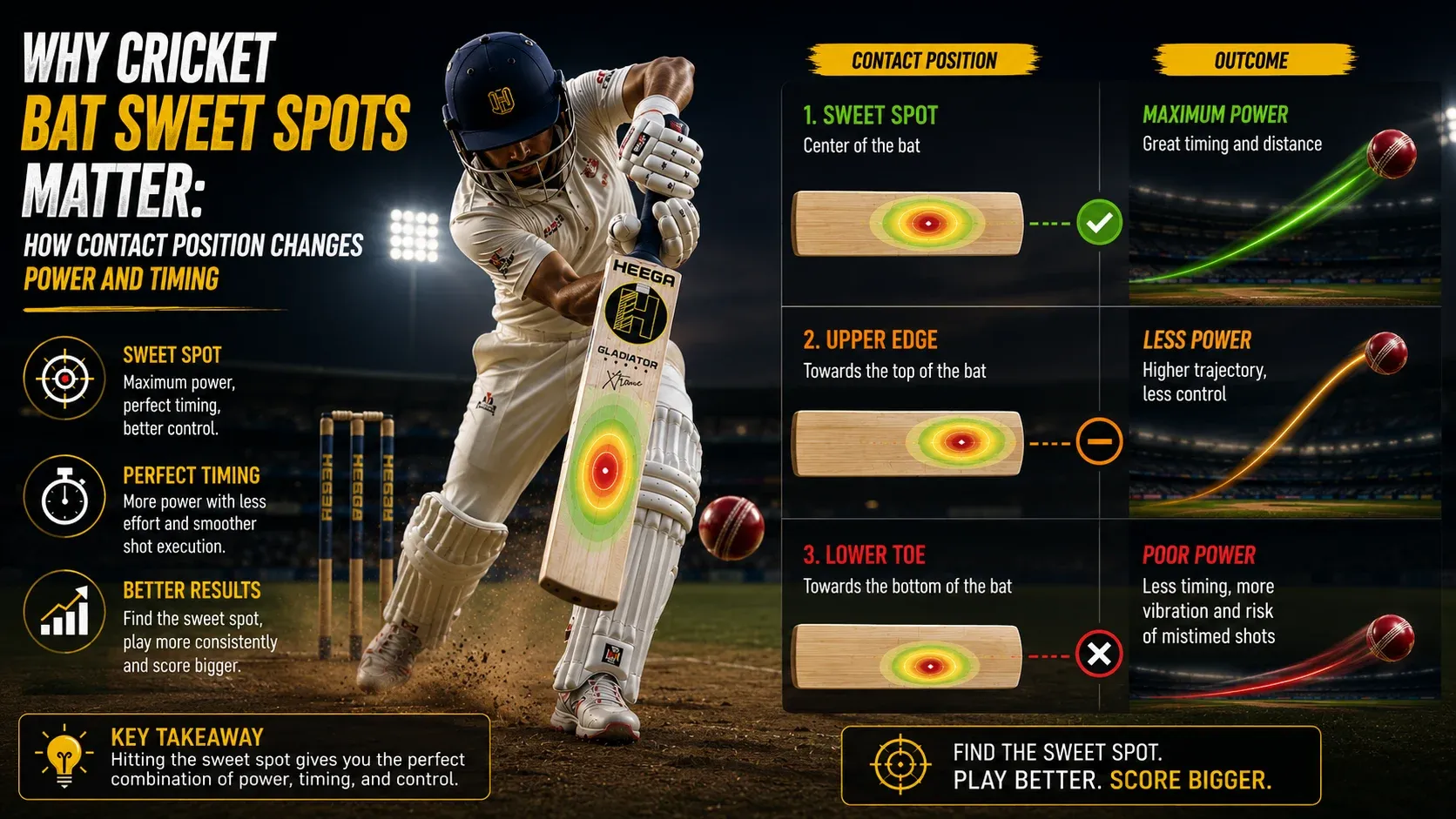
Why Contact Position Changes Power
When the ball strikes the bat cleanly, energy can be transferred efficiently.
When contact occurs away from the optimal area, more energy can be lost through vibration, bat movement, or inefficient impact.
This is one reason why two shots played with similar swings can travel very different distances.
Timing Is More Important Than Raw Strength
A strong player does not automatically hit the ball farther.
A batter with excellent timing can often produce impressive results without using excessive force.
The sweet spot supports this because clean contact allows the player's bat speed to be used more efficiently.
What Happens When Contact Is Clean?
A well-centered impact can create:
- Strong rebound
- Stable bat response
- Better control
- Efficient energy transfer
- A comfortable feeling in the hands
The shot may feel effortless.
What Happens When Contact Is Off-Centre?
Off-centre contact can create:
- Reduced power
- More vibration
- Less predictable rebound
- Bat twisting
- Poorer control
The result can be a shot that feels significantly weaker than expected.
Why Off-Centre Contact Can Vibrate More
When impact occurs away from the bat's most effective hitting area, more vibration can travel through the blade and handle.
The sensation depends on the bat's construction and the exact point of impact.
This is one reason players often immediately notice when they have not struck the ball cleanly.
Bat Twist Can Affect Control
When the ball hits away from the central hitting area, the bat can experience greater twisting forces.
This can make it harder for the batter to maintain control of the bat face.
Why Bat Face Stability Matters
A stable bat face helps the batter control the direction of the shot.
If the bat twists significantly at impact, the intended shot may not travel where expected.
Sweet Spot and Shot Direction
Contact position can influence more than power.
It can also influence the quality and direction of the shot.
A stable, clean impact gives the batter better control over the bat face.
The Role of Bat Angle
Even perfect contact is not enough if the bat angle is unsuitable.
The bat face determines where much of the ball's energy is directed.
For example, a slightly open or closed bat face can change the shot's trajectory.
Sweet Spot and Defensive Batting
The sweet spot matters even when the batter is not trying to hit a boundary.
A defensive shot can benefit from clean contact.
A well-timed defensive stroke can:
- Keep the ball close
- Reduce unnecessary vibration
- Maintain control
- Help the batter stay balanced
Sweet Spot and Attacking Shots
When playing attacking strokes, clean contact can maximize the effectiveness of the player's bat speed.
This is particularly important for:
- Drives
- Pull shots
- Cuts
- Flicks
- Lofted shots
Why Drives Often Feel Satisfying
A well-timed drive can create a smooth sensation because the batter combines good footwork, balance, bat path, and contact.
When the ball meets the responsive part of the blade, the result can feel exceptionally clean.
Timing Begins Before Contact
Timing is not simply about the exact moment the bat meets the ball.
It begins with reading the delivery.
The batter must judge:
- Length
- Line
- Speed
- Bounce
- Movement
Then the body needs to move into position.
Footwork Helps Find Better Contact
Good footwork places the batter in a position where the bat can meet the ball comfortably.
Poor footwork can force the batter to reach or stretch.
Why Positioning Matters More Than the Sweet Spot Alone
A batter cannot simply rely on the bat's sweet spot.
The player must bring the sweet spot to the ball.
That requires:
- Good balance
- Accurate footwork
- Proper head position
- Controlled bat movement
Head Position Supports Contact Quality
Keeping the head relatively stable can help the batter judge the ball accurately.
This supports better positioning at the moment of impact.
Bat Speed Also Matters
A bat's sweet spot cannot create power by itself.
The batter still needs sufficient bat speed.
The combination of:
Bat speed + clean contact + correct timing
creates effective shot-making.
Why Swinging Harder Is Not Always Better
Trying to hit every ball as hard as possible can actually reduce contact quality.
A batter may lose:
- Balance
- Control
- Timing
- Bat-face stability
A controlled swing can often produce better results.
The Importance of Pickup
Two bats can have the same listed weight but feel completely different.
This is because weight distribution affects how the bat feels when lifted and swung.
Bat Balance Can Affect Sweet Spot Access
A well-balanced bat can make it easier for a player to control the blade and position it correctly.
A bat that feels too bottom-heavy or too heavy overall may make precise contact more difficult for some players.
Weight Distribution Matters
Manufacturers can distribute wood differently across the blade.
This influences:
- Pickup
- Balance
- Swing feel
- Profile
- Player preference
Why a Lighter Bat Can Improve Timing
A lighter bat can allow some players to move the blade more quickly.
This may help with:
- Reaction time
- Bat speed
- Shot control
- Late adjustments
However, lighter does not always mean better.
Why a Heavier Bat Can Still Be Effective
A heavier bat can provide substantial momentum when controlled properly.
The important factor is whether the player can swing it comfortably and maintain technique.
Choosing the Right Weight Is Important
A bat should be appropriate for the player's:
- Age
- Strength
- Height
- Technique
- Playing style
Sweet Spot and Different Bat Profiles
Bat profile affects how the bat performs.
A bat with a larger profile may provide a different hitting feel from a thinner profile.
Thick Edges Do Not Automatically Mean Better Performance
Large edges can contribute to the overall profile and appearance of a bat.
But batting performance depends on the complete design rather than one measurement.
The Spine Influences Bat Shape
The spine is the raised central section running along the blade.
Its height and shape can affect weight distribution and the bat's profile.
Bow Also Influences Batting Feel
The bow is the slight curve incorporated into the blade.
Different bow profiles can influence how a bat feels during strokes.
Why Players Develop Different Preferences
A player who likes playing through the front foot may prefer a different bat profile from someone who relies heavily on back-foot shots.
There is no universal perfect bat.
Sweet Spot and Pitch Conditions
Playing conditions can influence which bat profile feels most suitable.
Low-Bouncing Conditions
A lower sweet spot may be preferred by some players who regularly play on lower-bouncing surfaces.
Bouncy Conditions
A higher sweet spot can appeal to players who often encounter faster and bouncier pitches.
All-Round Conditions
Players who regularly move between different surfaces may prefer a more versatile profile.
How to Find Your Bat's Sweet Spot
Players do not need complicated equipment to understand how their bat responds.
A simple controlled practice session can provide useful information.
Step 1: Use a Suitable Ball
Begin with a quality cricket ball or appropriate practice ball.
Step 2: Start With Controlled Shots
Do not begin by attempting maximum-power hitting.
Focus on clean contact.
Step 3: Notice the Feel
Pay attention to where the ball meets the blade and how the bat responds.
Step 4: Observe the Result
Look at:
- Ball speed
- Rebound
- Vibration
- Shot control
Step 5: Repeat the Test
Perform several controlled strokes.
One impact does not tell the complete story.
Coaches Can Help Identify Contact Problems
A coach can observe whether the issue is the bat or the player's technique.
This distinction is important.
A batter may think the bat lacks power when the actual problem is poor timing.
Video Analysis Can Help
Recording batting sessions can reveal where contact is occurring.
Slow-motion footage can show:
- Contact point
- Bat path
- Head position
- Footwork
- Bat angle
Batting Machines Can Help With Repetition
Controlled bowling-machine sessions can allow players to focus on contact quality.
The player can repeat similar deliveries and work on finding the ideal contact area.
Why Practice Balls Are Useful
Practice balls can help players work on timing without always requiring full match conditions.
They are particularly useful during technical drills.
Sweet Spot Training for Beginners
Young players should focus on learning clean contact rather than trying to maximize power.
A technically sound swing is more valuable than an uncontrolled big swing.
Why Children Should Avoid Oversized Bats
An oversized or excessively heavy bat can make it difficult for young players to control the blade.
This can reduce the quality of contact.
The Right Bat Helps Build Better Technique
When a player can comfortably control the bat, they have a better opportunity to develop:
- Timing
- Balance
- Hand-eye coordination
- Shot selection
Kashmir Willow and Sweet Spot Performance
Kashmir Willow bats are widely used by developing players because they can provide durability and accessible performance at different price points.
For beginners and developing cricketers, a suitable Kashmir Willow bat can be an excellent training option.
English Willow and Batting Performance
English Willow bats are commonly associated with higher-level cricket and are available in different grades and profiles.
However, simply choosing English Willow does not guarantee better batting.
The player's technique and suitability of the bat remain important.
Grade Is Not the Same as Sweet Spot
A higher grade of willow does not automatically mean the bat will have a better sweet spot for every player.
Bat design and profile matter too.
Why Players Should Test Pickup and Feel
Whenever possible, players should assess how the bat feels in their hands.
The ideal bat should feel comfortable rather than simply impressive on paper.
Common Mistakes Players Make
Several mistakes can prevent players from getting the most from their bat.
Choosing Weight Based Only on Appearance
A massive bat may look powerful but could be difficult to control.
Buying Only for Maximum Edges
Large edges are visually appealing, but they should not be the only buying consideration.
Ignoring Pickup
Listed weight does not tell the complete story.
Blaming the Bat for Poor Timing
Technical problems often have more influence on batting performance than the bat itself.
Changing Bats Too Frequently
Players need time to become familiar with a bat.
Constantly changing equipment can make it harder to develop consistency.
Why Familiarity With a Bat Matters
Once a player becomes accustomed to:
- Weight
- Pickup
- Handle
- Profile
- Sweet spot location
they can develop confidence in their equipment.
Bat Care Can Protect Performance
Even a quality bat needs proper care.
Players should follow appropriate maintenance practices.
Depending on the bat and manufacturer guidance, care may include:
- Knocking-in where required
- Using suitable bat oil
- Checking for cracks
- Avoiding excessive moisture
- Storing the bat correctly
Why Moisture Can Be a Problem
Wood can be affected by excessive moisture.
Players should avoid leaving cricket bats in damp environments.
Regular Inspection Is Important
Players should check the bat periodically for:
- Cracks
- Loose binding
- Surface damage
- Handle issues
Early attention can prevent minor problems from becoming more serious.
The Sweet Spot Does Not Replace Technique
This is perhaps the most important point.
A quality bat cannot compensate for poor batting fundamentals.
A player still needs:
- Good footwork
- Strong balance
- Correct head position
- Appropriate shot selection
- Good timing
Technology Is Changing Bat Design
Modern bat manufacturing increasingly uses detailed measurements and quality-control processes.
Manufacturers can analyze:
- Weight distribution
- Profile
- Edge thickness
- Spine shape
- Balance
These factors help create different performance characteristics.
Why Bat Testing Matters
Professional manufacturers test bats to understand how they perform.
Players benefit when products are produced consistently.
Every Bat Still Has Individual Characteristics
Natural willow is a material with variation.
Two bats from the same model can feel slightly different.
This is normal.
Why Players Should Find Their Own Preference
One player's ideal bat may not be another player's ideal bat.
The best choice depends on the individual.
How Heega Sports Helps Players Choose Better Cricket Equipment
At Heega Sports, we understand that selecting a cricket bat is about more than simply choosing a model.
Players need equipment that matches their playing style, level, strength, and preferences.
Our cricket range includes:
- Kashmir Willow cricket bats
- English Willow cricket bats
- Junior cricket bats
- Leather cricket balls
- Practice balls
- Batting gloves
- Batting pads
- Cricket helmets
- Cricket shoes
- Cricket kit bags
- Practice nets
- Cricket training accessories
Whether you're learning the basics or preparing for competitive cricket, choosing suitable equipment can help make practice more comfortable and productive.
Sweet Spot Awareness Can Make Players Better Batters
Understanding the sweet spot encourages players to focus on quality contact.
Instead of simply trying to hit harder, they begin thinking about:
- Where the ball meets the blade
- How the bat feels
- Whether the head is stable
- Whether the feet are correctly positioned
- Whether the shot was timed properly
This creates a more intelligent approach to batting development.
Final Thoughts
The sweet spot is one of the most important characteristics to understand when choosing and using a cricket bat.
It influences how the bat feels during impact and can contribute to efficient energy transfer, stability, rebound, and comfort.
But the sweet spot is only one part of the equation.
A batter must still bring the bat to the ball correctly.
Good footwork creates position.
Balance creates control.
Bat speed provides energy.
Timing coordinates everything.
When these elements come together, contact becomes cleaner and the shot becomes more effective.
That is why great batters do not simply swing harder.
They learn to find the right contact point again and again.
The best cricket bat is not necessarily the heaviest, largest, or most expensive one.
It is the bat that a player can control confidently and use to produce consistent, well-timed contact.
When the player and the bat work together, the sweet spot becomes more than a feature of the blade—it becomes part of better batting.
🏏 Find a Cricket Bat That Matches Your Game
Explore quality Kashmir Willow and English Willow cricket bats, along with leather balls, practice balls, batting gloves, pads, helmets, kit bags, practice nets, and cricket training accessories at Heega Sports.
Shop Now
Heega Sports – Helping Players Find Better Balance, Better Timing, and Better Batting Performance.
Related posts
 Cricket Bat Sweet Spot Explained: How Its Position Affects Your Batting.Learn what a cricket bat sweet spot is and how its position affects timing, power, balance, shot selection, and performance for different players.
 Why Cricket Bat Sweet Spot Position Matters for Different Playing Styles and Shot SelectionLearn how cricket bat sweet spot position affects timing, power, balance, shot selection, and playing style, and discover which position suits different batters.
 Cricket Rules for Kids Explained: Understanding Runs, Wickets, Overs and Fielding Positions.Learn cricket rules for kids, including runs, wickets, overs, fielding positions, batting, bowling, and basic match rules in a simple beginner's guide.