Why Cricket Partnerships Matter More Than Individual Batting Performances.

Introduction: Cricket Is Not Won by One Batter Alone
A batter can score a brilliant century and still end up on the losing side.
That is one of the interesting things about cricket.
Individual performances matter. A big score can change the direction of an innings, and a player who spends hours at the crease can give their team a strong platform.
But cricket is ultimately a team sport.
One batter cannot score every run.
One player cannot face every delivery.
And one individual performance does not always guarantee a winning total.
This is where cricket partnerships become so important.
A good partnership allows two batters to work together, share pressure, rotate the strike, communicate clearly, and build an innings one delivery at a time.
Sometimes the partnership between two batters is more valuable than either player's individual score.
Why?
Because the partnership creates stability.
It gives the team time to recover after losing a wicket.
It can change the momentum of an innings.
It can force the opposition captain to rethink field placements.
And most importantly, it keeps two batters at the crease.
That final point is easy to overlook.
In many situations, two batters who contribute moderately together can be more useful than one batter producing an exceptional score while wickets fall around them.
Cricket is about runs, but it is also about partnerships, pressure, timing, and teamwork.
What Is a Cricket Partnership?
A cricket partnership refers to the runs scored by two batters while they are batting together before one of them is dismissed.
For example, if two players add 100 runs before the first wicket falls, they have produced a 100-run partnership.
Their individual scores might be:
- Batter A: 65
- Batter B: 35
The partnership is still 100 runs.
This is important because the partnership measures something that individual statistics cannot fully show.
It shows how effectively two players worked together.
They may have played very different roles.
One might attack.
The other might defend.
One might rotate the strike.
The other might hit boundaries.
Together, however, they create one batting unit.
Why Partnerships Matter in Cricket
A partnership provides several benefits to a batting team.
It can:
- Build the team's total.
- Reduce pressure on individual players.
- Rotate the strike.
- Create scoring opportunities.
- Disrupt the opposition's plans.
- Allow batters to settle.
- Protect against regular wicket loss.
- Create momentum.
A team does not always need two batters scoring at exactly the same rate.
What matters is that they complement each other.
One player might score quickly while the other takes fewer risks.
Another partnership might involve both batters rotating the strike constantly.
Different combinations can work in different match situations.
Two Batters Can Share the Pressure
Batting can be mentally demanding.
A batter has to watch the bowler, judge the delivery, choose a shot, assess the field, and remain focused.
Doing all of this while carrying the entire team's scoring responsibility can be difficult.
A partnership spreads that responsibility.
If one batter struggles for a few overs, the other can keep the scoreboard moving.
If one batter feels pressure after playing several dot balls, their partner may find a boundary or take a quick single.
The partnership becomes a form of support.
That support can be extremely valuable during difficult periods.
Partnerships Give Batters Time to Settle
A new batter often needs time to understand the conditions.
They may need to adjust to:
- The pitch.
- The bounce.
- The pace of the wicket.
- The bowling attack.
- The field placement.
- The match situation.
A settled partner can make this process easier.
The established batter can continue scoring while the new player finds their rhythm.
Once both batters become comfortable, the partnership can accelerate.
This is particularly important after an early wicket.
Building an Innings Is Often About Patience
Not every innings begins with attacking cricket.
Sometimes the first objective is simply to survive.
Batters may need to spend time understanding the conditions before taking bigger risks.
A partnership allows this approach.
Instead of asking every batter to score quickly from the beginning, two players can gradually build confidence.
The scoreboard may move slowly at first.
Then the scoring rate can increase once the batters are comfortable.
This is one reason long partnerships can be so valuable.
The Importance of Strike Rotation
One of the simplest ways partnerships work is through strike rotation.
Batters can use singles and twos to keep the scoreboard moving.
This has several benefits.
It:
- Prevents long periods of dot balls.
- Gives both batters opportunities to face deliveries.
- Keeps fielders moving.
- Disrupts the bowler's rhythm.
- Creates gaps in the field.
Good communication between partners makes strike rotation much easier.
Communication Is at the Heart of a Good Partnership
Two batters need to communicate constantly.
They communicate about:
- Running.
- Field placements.
- Bowling changes.
- Scoring opportunities.
- Match situations.
- Risk levels.
A simple call can prevent a run-out.
A quick discussion between overs can identify a weakness in the field.
A partner can also provide reassurance after a difficult delivery.
Communication may not appear on the scorecard.
But it can influence the entire innings.
Trust Between Batters Matters
Running between the wickets requires trust.
If one batter calls "yes," the other needs to respond quickly.
If the call is "no," both need to stop.
This trust develops with experience.
Batters begin to understand each other's running style.
They learn:
- Who calls more often.
- Who accelerates quickly.
- Who prefers to take fewer risks.
- Who notices fielding mistakes.
- How quickly each player turns.
A strong partnership often develops its own rhythm.
Partnerships Can Change the Field
A batting partnership can influence the opposition's field placement.
Imagine two batters repeatedly taking singles through cover.
The captain may move a fielder into that area.
That could create another gap somewhere else.
The batters can then target the new space.
This becomes a tactical battle.
The batting team is not simply reacting to the field.
It is influencing the field.
Partnerships Can Force Bowling Changes
A long partnership can also put pressure on the captain.
If one bowler cannot break the partnership, the captain may introduce another option.
That could mean:
- A fast bowler.
- A spinner.
- A different angle.
- A change in pace.
- A different field.
Every bowling change gives the batters new information.
They can assess the new bowler and look for scoring opportunities.
A partnership therefore affects more than the batting side.
It influences the opposition's strategy too.
Why Wickets in Clusters Can Be Dangerous
Losing one wicket is part of cricket.
Losing several wickets quickly is much more damaging.
A team may begin an innings strongly but collapse after losing two or three batters in quick succession.
This is why partnerships are valuable.
They interrupt potential collapses.
Two batters at the crease can absorb pressure and give the next players time to prepare.
A stable partnership can prevent a difficult situation from becoming a disaster.
Partnerships After Early Wickets
Suppose a team loses two wickets early.
The situation may suddenly look uncomfortable.
The next two batters have an important job.
They do not necessarily need to score rapidly.
Their first responsibility may be to rebuild.
They can:
- Defend good deliveries.
- Rotate the strike.
- Reduce risky shots.
- Build confidence.
- Wait for scoring opportunities.
Once the innings stabilizes, the team can attack again.
This rebuilding process is often driven by partnership batting.
Middle-Order Partnerships Can Rescue an Innings
Middle-order batters often enter situations where the team needs stability.
They may arrive after an opening partnership has ended or after several wickets have fallen.
A good middle-order partnership can completely change the situation.
For example, a team struggling at 80 for 4 may eventually reach 250 because two middle-order players spend significant time together.
Neither batter may score a spectacular century.
But their partnership could be the reason the team reaches a competitive total.
Lower-Order Partnerships Can Be Extremely Valuable
Partnerships are not only important between top-order batters.
Lower-order players can also contribute significantly.
A tailender may not have the same batting technique as a specialist batter.
But if they can stay at the crease while their partner scores, they can add valuable runs.
Even a 30-run partnership late in an innings can change the final target.
In a close match, those runs can be decisive.
Test Cricket Depends Heavily on Partnerships
Partnerships have a special importance in Test cricket.
There are many opportunities to build long innings.
Batters may spend hours at the crease.
The objective is often to absorb pressure before capitalizing on scoring opportunities.
A strong partnership can:
- Wear down bowlers.
- Reduce the effectiveness of the new ball.
- Force defensive fields.
- Change the match tempo.
- Build a large first-innings total.
- Save a team from defeat.
In Test matches, patience and partnership building can be just as important as individual centuries.
Partnerships in Limited-Overs Cricket
Limited-overs cricket creates a different challenge.
There is a fixed number of deliveries available.
That means partnerships need to balance stability with scoring speed.
In ODI cricket, batters may build a partnership gradually before accelerating later.
In T20 cricket, the time available is much shorter.
Batters may need to score quickly while still avoiding unnecessary wickets.
The principles remain similar:
Stay together, communicate, rotate the strike, and maximize scoring opportunities.
T20 Partnerships Can Change Matches Quickly
T20 cricket can change direction within a few overs.
A team might be struggling at 40 for 2.
Two batters could add 70 runs together in the next six overs.
Suddenly, the required scoring rate becomes manageable.
The partnership does not need to produce two individual stars.
It simply needs to keep the innings moving.
This is one reason T20 teams often value batting combinations rather than individual reputations alone.
Partnerships and the Required Run Rate
During a chase, partnerships become even more important.
The batting team knows exactly how many runs are required.
If wickets fall regularly, pressure increases.
A stable partnership can bring control back into the chase.
The batters can calculate:
- Runs required.
- Balls remaining.
- Current run rate.
- Required run rate.
- Number of wickets remaining.
This information helps them decide when to attack and when to remain patient.
A Partnership Can Make a Difficult Chase Look Easier
Imagine a team needs 100 runs from 90 balls.
If two batters remain at the crease, the target may look manageable.
They can rotate the strike and wait for boundary opportunities.
But if the team loses three wickets during the next 20 balls, the same target suddenly becomes much more difficult.
This shows why wickets and partnerships matter alongside the required run rate.
A team needs runs.
But it also needs batters at the crease to score them.
Individual Scores Can Sometimes Be Misleading
Statistics are useful.
But they do not always tell the complete story.
A batter may score 80 runs in a team total of 180.
That sounds impressive.
However, if they consumed a large number of deliveries and their team needed faster scoring, the context changes.
Another batter may score 45 from fewer deliveries while forming a crucial partnership that changes the match.
This does not make the 80 less valuable.
It simply shows why individual scores should be understood within the context of the innings.
Partnerships Create Different Batting Roles
Two players do not have to bat identically.
A successful partnership can involve complementary roles.
For example:
The Anchor
One batter focuses on stability and minimizes risky shots.
The Aggressor
The other looks for boundaries and attacks weaker deliveries.
This combination can work particularly well in limited-overs cricket.
The roles can also change.
An anchor may begin attacking once they are settled.
An aggressive batter may slow down temporarily when the team loses a wicket.
Flexibility is part of good partnership batting.
Left-Hand and Right-Hand Combinations
A left-hand/right-hand batting combination can sometimes create additional challenges for bowlers.
The bowler may have to adjust their angle.
Fielders may need to move.
The captain may need to think about different matchups.
Every time the batters rotate the strike, the bowler may face a different batter.
This can make it harder to settle into a consistent plan.
The advantage is not automatic, but the combination can create tactical opportunities.
Partnerships Can Tire Out Bowlers
Long partnerships can become physically and mentally demanding for the bowling team.
Bowlers have to repeat their run-ups.
Fielders have to stay alert.
Captains have to keep changing plans.
Meanwhile, the batters may continue rotating the strike.
As the partnership grows, frustration can increase.
That frustration can produce mistakes.
A bowler may attempt something different.
A fielder may lose concentration.
The batting team can take advantage.
The Mental Battle of a Partnership
Cricket is not only about physical skill.
It is also a mental contest.
A long partnership can frustrate the opposition.
The fielding team may begin thinking:
"How are we going to break this partnership?"
That question creates pressure.
The batting pair can use that pressure intelligently.
They do not need to attack every ball.
They simply need to stay focused and wait for opportunities.
Partnerships Build Confidence
Confidence can grow as two batters spend more time together.
They begin to understand the pitch.
They understand the bowlers.
They recognize scoring areas.
They become more comfortable running together.
Every successful over reinforces that confidence.
This can create a positive cycle:
Good communication → Better decisions → More runs → Greater confidence → Better partnership.
The Importance of Supporting Your Partner
A partnership is not about competing with the person at the other end.
Both players are working toward the same goal.
A batter who scores 30 may still make an enormous contribution if their partner scores 100.
The 30-run player may have:
- Rotated the strike.
- Taken pressure off their partner.
- Stayed at the crease.
- Communicated clearly.
- Helped build the innings.
Those contributions may not always receive headlines.
They still matter.
Partnerships and Team Morale
A strong partnership can lift the entire team.
Players in the dressing room see the scoreboard moving.
The coaching staff can relax slightly.
The opposition becomes frustrated.
Confidence spreads through the team.
This psychological effect can be particularly powerful in close matches.
One partnership can change how everyone views the game.
Fielders Feel the Pressure Too
When a partnership becomes established, fielders know that every mistake matters.
A misfield may produce an extra run.
A missed catch can allow a batter to continue.
A slow throw may turn one into two.
As the partnership grows, fielding pressure can increase.
Good batters remain alert and take advantage of these small opportunities.
Partnerships and Running Between the Wickets
Running is one of the easiest ways for a partnership to grow.
Batters can score without taking the risk of a boundary every delivery.
A well-placed shot can become one.
A fielder's slow pickup can turn it into two.
Good communication allows both players to run efficiently.
Over time, these small runs can create a large partnership.
Partnerships Can Be Built Through Simple Cricket
Not every partnership is filled with spectacular shots.
Sometimes the best partnerships are surprisingly ordinary.
Two players defend the good balls.
They leave deliveries outside their scoring areas.
They take singles when available.
They punish loose deliveries.
They communicate.
They repeat the process.
There may be nothing dramatic about it.
But after an hour, they may have added 80 runs.
That is the beauty of partnership batting.
How Young Players Can Learn Partnership Batting
Young cricketers should learn that batting is not always about personal scores.
Coaches can create partnership-based drills.
For example:
Two players can be given a target of 40 runs.
They receive points for:
- Running safely.
- Clear communication.
- Rotating strike.
- Taking calculated risks.
- Supporting each other.
This teaches children to think about batting as a shared responsibility.
Parents Can Encourage Team-Focused Batting
Parents naturally want to see their child score runs.
That is understandable.
But young players should also be praised for helping teammates.
A child who scores 20 while building a 60-run partnership has made an important contribution.
Parents can ask:
- Did you communicate well?
- Did you support your partner?
- Did you make good running decisions?
- Did you help the team recover?
- Did you understand the match situation?
These questions encourage a healthier approach to development.
Coaches Can Teach Partnership Awareness
Coaches can help players understand different partnership situations.
For example:
After an Early Wicket
Focus on stability.
During a Successful Chase
Keep rotating the strike.
When the Run Rate Is Too Low
Look for controlled scoring opportunities.
Near the End of an Innings
Increase attacking intent.
When a Partner Is Struggling
Offer support and reduce unnecessary pressure.
Understanding the situation is part of becoming a complete batter.
Equipment Still Has a Supporting Role
Partnership batting is mainly about communication, technique, and decision-making.
However, suitable equipment can help players train comfortably.
A correctly sized cricket bat can make batting movements easier to control.
Comfortable batting gloves can help players maintain a secure grip.
Well-fitted batting pads allow players to move between wickets without unnecessary restriction.
Reliable cricket shoes can support movement during quick singles and turns.
The equipment does not create the partnership.
It simply helps players perform their roles comfortably.
Why Heega Sports Supports Team-Focused Cricket
At Heega Sports, we believe cricket equipment should support players throughout their development.
Whether a player is learning basic batting skills or competing at a higher level, dependable equipment can contribute to better training sessions.
Our cricket range includes:
- Kashmir Willow cricket bats.
- English Willow cricket bats.
- Junior cricket bats.
- Cricket bat grips.
- Leather cricket balls.
- Practice cricket balls.
- Batting gloves.
- Batting pads.
- Cricket helmets.
- Cricket shoes.
- Cricket kit bags.
- Practice nets.
- Training accessories.
Good equipment supports the player.
Good teamwork supports the team.
Both matter.
What Makes a Great Batting Partnership?
A strong partnership usually includes several qualities.
Communication
Both players understand each other.
Trust
They trust each other's calls.
Patience
They do not panic after a few dot balls.
Awareness
They understand the field and match situation.
Adaptability
They can change their approach when conditions change.
Running
They take available singles and twos.
Support
They help each other through difficult periods.
These qualities can turn two individual batters into one effective batting unit.
Famous Partnerships Are Remembered for a Reason
Cricket history contains many memorable partnerships.
Fans often remember these stands because they changed important matches.
A partnership can:
- Rescue a team from trouble.
- Set up a huge total.
- Chase a difficult target.
- Survive against a strong bowling attack.
- Take a match away from the opposition.
The individual scores matter.
But the partnership tells the bigger story.
It explains how two players worked together to achieve something neither could have achieved alone.
Partnership Batting Is About Reading the Match
A good partnership does not follow one fixed formula.
The correct approach depends on the situation.
If the team is 20 for 2, survival may be the priority.
If the team is 180 for 2 in an ODI, acceleration may become more important.
If a T20 chase requires 60 from 30 balls, risk-taking becomes unavoidable.
The partnership must adapt.
That is what makes partnership batting a skill rather than simply a statistic.
Why Partnerships Matter More Than Individual Brilliance
Individual brilliance can win moments.
Partnerships can control phases of a match.
One batter can produce a spectacular innings.
But if wickets fall at the other end, the team may still struggle.
Two batters working together create stability.
They create options.
They share pressure.
They manipulate the field.
They run hard.
They communicate.
And they give the team a better chance of building a competitive total.
This does not mean individual performances are unimportant.
Quite the opposite.
Individual brilliance often becomes even more effective when it is supported by a strong partner.
The key is understanding that cricket rewards combinations as much as individual talent.
Final Thoughts
Cricket is full of individual statistics.
Runs.
Centuries.
Strike rates.
Averages.
Sixes.
Wickets.
These numbers help us understand player performance.
But they do not always explain how a team actually wins.
Partnerships provide another perspective.
They show how two players combine their skills to move an innings forward.
A partnership can stabilize a team after early wickets.
It can allow a new batter to settle.
It can keep the scoreboard moving through singles and twos.
It can force changes in field placement.
It can pressure bowlers.
It can frustrate fielders.
And in a close chase, it can provide the stability needed to reach the target.
The best partnerships are not necessarily made up of two players scoring identical numbers.
They are often built by players who understand their different roles.
One may attack.
One may defend.
One may run particularly well.
One may find boundaries.
One may have more experience.
The important thing is that both players contribute to the same objective.
For young cricketers, this is an important lesson.
Your score matters.
But helping your team matters more.
A 30-run innings can be incredibly valuable if it creates a 70-run partnership.
A quick 20 can change the momentum.
A smart single can keep your partner on strike.
A clear call can prevent a run-out.
A few words of encouragement can help a struggling teammate regain confidence.
These are all parts of partnership cricket.
The next time you watch a batter score a century, look beyond the individual number.
Ask how many runs came while their partner was at the other end.
Look at the communication.
Watch the running.
Notice how the field changes.
Pay attention to how the partnership develops.
You may discover that the real story of the innings was not one batter's score.
It was the relationship between the two players at the crease.
Because cricket is not simply about how many runs one player can score.
It is about how effectively players combine their skills to help the entire team succeed.
And sometimes, the partnership is where the real match-winning performance begins.
🏏 Build Better Cricket Partnerships With Heega Sports
Explore Kashmir Willow and English Willow cricket bats, junior cricket bats, leather and practice cricket balls, batting gloves, batting pads, helmets, cricket shoes, kit bags, practice nets, and training accessories for players and teams.
Shop Now
Heega Sports – Supporting Better Players, Stronger Partnerships, and Better Cricket.
Related posts
 Cricket Batting Pads Explained: How Knee Protection, Shin Coverage and Strap Placement Affect Comfort and MobilityLearn how cricket batting pads, knee protection, shin coverage and strap placement affect comfort, mobility, impact protection and batting performance.
 Batting Gloves for Cricket: How Finger Design, Palm Materials and Grip Texture Affect Bat ControlDiscover how cricket batting gloves, finger design, palm materials and grip texture influence bat control, comfort, protection and batting performance.
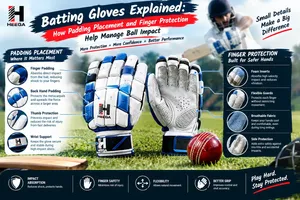 Batting Gloves Explained: How Padding Placement and Finger Protection Help Manage Ball ImpactLearn how batting glove padding placement, finger protection, and fit help manage ball impact. Find practical tips for choosing cricket batting gloves.