Why Cricket Players Practice the Same Shot Hundreds of Times: The Science of Muscle Memory

Introduction: Why Do Cricketers Repeat the Same Shot Again and Again?
Walk into a cricket academy during a training session and you may notice something surprising.
A batter hits the same drive repeatedly.
A coach feeds another delivery.
The batter plays the same movement again.
And again.
And again.
To someone watching from outside, this may seem repetitive.
Why would an experienced player spend so much time practicing a shot they already know how to play?
The answer lies in one of the most important principles of skill development:
repetition helps the body become more efficient at performing familiar movements.
Cricket involves extremely fast decisions. A batter cannot consciously think through every movement of their feet, hands, shoulders, wrists, and head during every delivery.
Through repeated practice, important movement patterns become increasingly familiar.
This is often described as muscle memory.
However, the term can be slightly misleading.
Muscles do not literally remember instructions like a computer.
Instead, repeated practice helps the brain and nervous system become more efficient at coordinating learned movements.
That is why a shot that once required intense concentration can eventually feel natural.
What Is Muscle Memory?
Muscle memory is commonly used to describe the ability to perform a practiced movement with less conscious effort.
For a cricket batter, this could include:
- Lifting the bat.
- Moving the front foot.
- Shifting weight.
- Rotating the body.
- Bringing the bat through.
- Making contact.
- Completing the follow-through.
The more consistently these movements are practiced, the more familiar the overall pattern becomes.
Does the Muscle Actually Remember the Shot?
Not exactly.
The term "muscle memory" is a convenient way of describing learned motor skills.
The brain, nervous system, and muscles work together to coordinate movement.
Repeated practice strengthens the player's ability to reproduce a movement pattern.
This is why experienced players can sometimes execute a familiar shot without consciously thinking about every individual step.
Why Repetition Matters So Much in Cricket
Cricket requires precision.
A batter may have only a very short period to react to a delivery.
There is no time to consciously calculate:
"Move my foot here, rotate my hips, lower the bat, adjust my wrists, and now make contact."
Instead, the player needs a trained movement system that can respond efficiently.
Repetition helps build that system.
The First Attempt Is Usually Awkward
When learning a new cricket shot, the movement may feel unnatural.
A beginner might struggle with:
- Foot placement.
- Bat angle.
- Balance.
- Timing.
- Grip.
- Head position.
This is normal.
The brain is learning how the different parts of the body need to work together.
Repetition Makes Movements More Familiar
With practice, the player begins recognizing the movement more easily.
The footwork becomes smoother.
The bat path becomes more consistent.
The player begins to understand where contact should occur.
Over time, the movement requires less conscious attention.
But Repetition Alone Is Not Enough
This is an important point.
Repeating a movement hundreds of times does not automatically make it better.
If a player repeatedly practices poor technique, they may become very consistent at performing the wrong movement.
That is why quality of repetition matters.
Practice the Correct Movement
Effective cricket training should combine:
- Correct technique.
- Repetition.
- Feedback.
- Gradual challenge.
- Match-like situations.
The goal is not simply to repeat.
The goal is to repeat correctly.
What Is Deliberate Practice?
Deliberate practice means training with a specific purpose.
Instead of simply hitting hundreds of balls, a batter may focus on one particular skill.
For example:
- Playing straight.
- Moving forward correctly.
- Keeping the head still.
- Controlling the bat face.
- Improving timing.
Each repetition has a purpose.
Why Coaches Feed Repeated Deliveries
Coaches often use throwdowns or bowling machines to provide similar deliveries repeatedly.
This allows the player to concentrate on one movement without constantly adjusting to completely different conditions.
Repetition Builds Coordination
A cricket shot involves multiple body parts.
For a front-foot drive, the player may need to coordinate:
- Feet.
- Knees.
- Hips.
- Core.
- Shoulders.
- Arms.
- Wrists.
- Eyes.
The movement only works properly when these components are coordinated.
Why Coordination Takes Time
The body needs to learn the correct sequence.
If the foot moves too late, the batter may lose balance.
If the head moves too early, visual tracking may suffer.
If the bat arrives too late, timing disappears.
Repetition helps players identify and refine these relationships.
The Brain Learns Movement Patterns
Every successful repetition provides information.
The player receives feedback about:
- Where the ball went.
- How the shot felt.
- Whether balance was maintained.
- Whether contact was clean.
- Whether the desired result occurred.
The brain can use this information to refine future attempts.
Why Feedback Is Essential
A player may not notice every technical error themselves.
A coach can identify:
- An unnecessary movement.
- Incorrect footwork.
- Poor bat angle.
- Excessive grip pressure.
- Head movement.
Correcting these issues during practice prevents them from becoming deeply established habits.
Video Analysis Can Help
Recording batting sessions allows players to see their technique from outside their own perspective.
They can compare:
- Good shots.
- Mistimed shots.
- Successful footwork.
- Poor balance.
This can make technical improvements easier to understand.
The Role of Consistency
A player needs to perform a movement consistently before it can become reliable under pressure.
If the same shot looks completely different every time, the player has not yet developed a stable movement pattern.
Repetition Creates Familiarity
Repeated practice makes the situation less unfamiliar.
A batter who has faced hundreds of similar deliveries may feel more comfortable when a similar situation appears in a match.
Training Under Different Conditions
However, players should not practice only one perfectly predictable delivery.
Eventually, practice needs to become more variable.
A batter should learn to perform the same basic skill against different:
- Speeds.
- Lines.
- Lengths.
- Angles.
- Bowling styles.
This helps prevent the skill from becoming overly dependent on one training environment.
From Repetition to Adaptability
Good training follows a progression.
Stage 1: Learn the Movement
Understand the basic technique.
Stage 2: Repeat the Movement
Develop consistency.
Stage 3: Add Variation
Change speed, line, and length.
Stage 4: Add Pressure
Introduce targets and consequences.
Stage 5: Apply It in Matches
Use the skill naturally during competition.
Why the Same Shot Can Look Different Against Different Balls
A batter may practice a cover drive hundreds of times.
But in a match, every delivery is slightly different.
The player may need to adjust:
- Foot movement.
- Bat angle.
- Timing.
- Distance from the body.
The basic skill remains the same, but execution adapts.
Muscle Memory Should Not Mean Mindless Batting
A common misconception is that automatic movement means players stop thinking.
That is not true.
Elite batters still read:
- The bowler.
- The release point.
- The line.
- The length.
- The field.
- The match situation.
Their practiced technique simply allows them to execute the chosen response more efficiently.
Reading and Execution Work Together
A batter might recognize a full delivery.
The brain decides that a drive is appropriate.
The trained movement system then helps execute the shot.
This separation between decision and movement is extremely useful in cricket.
Why Practice Reduces Mental Load
If every physical movement required conscious attention, batting would become overwhelming.
Automaticity allows the player to focus more attention on the changing aspects of the game.
For example, instead of thinking about how to move their front foot, the batter can focus on whether the ball is swinging.
Repetition Can Improve Confidence
Confidence often grows when players know they can reproduce a skill.
Repeated successful practice gives players evidence that they can perform the movement.
But Confidence Should Come From Preparation
Players should not rely on confidence alone.
The strongest confidence usually comes from:
- Preparation.
- Repetition.
- Feedback.
- Experience.
Why Players Practice Defensive Shots Repeatedly
Defensive shots may not look exciting, but they are fundamental.
A batter needs to know how to protect their wicket when the ball is difficult to attack.
Repeated defensive practice helps develop:
- Stable head position.
- Soft hands.
- Bat control.
- Balance.
Why Drives Need Repetition
Drives require precise coordination.
The batter needs to move into position and present the bat correctly.
Small errors can produce edges or mistimed shots.
Repetition helps refine the movement.
Why Pull Shots Need Repetition
Pulling requires quick recognition and coordinated body rotation.
The player must identify the short ball and move into position quickly.
Repeated practice improves familiarity with the movement.
Why Cut Shots Need Repetition
The cut shot requires judgment of width and length.
The player needs to create enough room while controlling the bat.
Repetition helps connect decision-making with execution.
Why Flicks Need Repetition
Flick shots rely on timing and wrist control.
Players need to learn how much movement is required rather than simply using maximum force.
Why Sweeps Need Repetition
Sweep shots against spin involve:
- Reading the ball.
- Moving into position.
- Lowering the body.
- Controlling the bat.
Because the movement is relatively complex, repetition can be especially valuable.
Repetition in Bowling
Muscle memory is not limited to batting.
Bowlers also repeat their actions.
They practice:
- Run-up rhythm.
- Bowling arm position.
- Release point.
- Seam position.
- Follow-through.
Why Bowlers Repeat Their Run-Up
Consistency in the run-up helps create a repeatable delivery stride.
A reliable approach can support better control of:
- Pace.
- Line.
- Length.
Repetition in Fast Bowling
Fast bowlers need to coordinate their entire body during delivery.
The movement includes:
- Run-up.
- Jump or gather.
- Front-foot landing.
- Hip rotation.
- Shoulder rotation.
- Arm speed.
- Release.
- Follow-through.
This complex sequence requires extensive practice.
Repetition in Spin Bowling
Spinners also need consistency.
They repeatedly practice:
- Grip.
- Finger action.
- Wrist position.
- Release.
- Flight.
- Follow-through.
Fielders Use Repetition Too
Fielding drills are another example.
Players repeatedly practice:
- Ground pickups.
- Throws.
- High catches.
- Close catches.
- Diving stops.
The objective is to make the basic movement reliable.
Wicketkeepers Need Highly Repeated Movements
Wicketkeepers react to deliveries repeatedly throughout a match.
They practice:
- Squatting.
- Rising.
- Moving laterally.
- Catching.
- Collecting the ball.
- Throwing.
Repetition helps develop efficient movement patterns.
Reaction Training and Repetition
Reaction drills can also improve familiarity with rapid situations.
Players may use:
- Reaction balls.
- Close catches.
- Random throws.
- Deflection drills.
The important element is responding quickly and correctly.
Why Random Practice Becomes Important
Once a skill has been learned, predictable practice can become less useful.
Randomized practice forces the player to make decisions.
For example, a coach may randomly bowl:
- Full.
- Short.
- Outside off.
- At the body.
The batter must recognize the delivery and choose the correct response.
Block Practice vs Variable Practice
Block practice involves repeating a similar movement many times.
It is useful during the early stages of learning.
Variable practice introduces different situations.
It helps players transfer the skill into real match conditions.
Both have a place in cricket development.
Why Match Simulation Matters
A skill that works perfectly in practice may fail under pressure.
Match simulation adds:
- Field settings.
- Targets.
- Time limits.
- Wickets.
- Scoreboard pressure.
This tests whether the learned movement can survive realistic conditions.
Pressure Can Change Technique
Under pressure, players may:
- Grip the bat too tightly.
- Rush footwork.
- Swing too hard.
- Lose balance.
This is why skills need to be practiced under increasing levels of pressure.
Automatic Skills Can Help Under Pressure
When a movement is deeply familiar, players may be less likely to completely abandon their technique during stressful moments.
The practiced movement gives them something reliable to return to.
But Automaticity Does Not Guarantee Success
Even highly trained players make mistakes.
Cricket involves unpredictable:
- Bounce.
- Movement.
- Bowling variations.
- Field placements.
- Match situations.
Practice improves preparation, not certainty.
Repetition and Young Cricketers
Young players benefit greatly from repetition, but training should remain enjoyable.
Children should not spend every session performing the same drill without variation.
Good youth coaching combines:
- Repetition.
- Games.
- Challenges.
- Competition.
- Creativity.
Why Fun Improves Engagement
Players are more likely to continue practicing when they enjoy the experience.
Long-term participation is more important than forcing excessive repetition.
Avoiding Boredom in Training
Coaches can vary drills while practicing the same underlying skill.
For example, a player working on driving can practice:
- Front-foot drives.
- Target hitting.
- Scoring games.
- Throwdowns.
- Bowling-machine drills.
The skill remains consistent while the activity changes.
Repetition and Equipment
Reliable equipment makes repeated practice easier.
A batter needs a suitable bat.
A coach needs appropriate balls.
An academy needs nets and training equipment.
Protective gear is important when facing harder deliveries.
Why the Right Bat Matters
A bat that is too heavy can make repeated practice difficult.
Players should use equipment appropriate to their:
- Height.
- Strength.
- Age.
- Skill level.
Comfort helps players maintain good technique during longer sessions.
Why Practice Balls Are Useful
Practice balls allow players to repeat skills without always requiring match-quality equipment.
Different ball types can also help coaches create different training situations.
Practice Nets Support Repetition
Nets allow players to face repeated deliveries without needing a full match environment.
They are especially useful for:
- Batting technique.
- Bowling accuracy.
- Reaction drills.
Heega Sports and Cricket Training
At Heega Sports, we understand that cricket improvement depends heavily on consistent practice.
Our cricket range includes:
- Kashmir Willow cricket bats.
- English Willow cricket bats.
- Leather cricket balls.
- Practice balls.
- Batting gloves.
- Batting pads.
- Cricket helmets.
- Cricket shoes.
- Cricket kit bags.
- Practice nets.
- Training accessories.
The right equipment can help players create a more effective and comfortable training environment.
How to Practice a Shot Effectively
Players can follow a simple progression.
Step 1: Understand the Technique
Learn the correct movement from a qualified coach.
Step 2: Start Slowly
Practice the movement without pressure.
Step 3: Repeat Correctly
Focus on quality rather than simply counting repetitions.
Step 4: Introduce a Ball
Add controlled deliveries.
Step 5: Add Variation
Change line, length, and speed.
Step 6: Add Decision-Making
Make the player choose the appropriate shot.
Step 7: Add Pressure
Introduce targets, scoring, or match situations.
Step 8: Test It in Matches
The final goal is practical performance.
How Many Times Should a Player Practice?
There is no universal number.
The ideal amount depends on:
- Age.
- Skill level.
- Training goals.
- Physical condition.
- Session duration.
More repetitions are not automatically better.
Quality and recovery matter.
Why Recovery Still Matters
Repetition creates physical and mental fatigue.
Players need appropriate recovery between sessions.
Good training should include:
- Rest.
- Hydration.
- Sleep.
- Mobility.
- Appropriate workload.
Different Players Need Different Amounts of Practice
A beginner may need more time learning basic movement.
An experienced player may focus on refining small technical details.
Training should therefore be individualized.
Repetition Across Global Cricket
Cricket continues developing across Nepal, Germany, the United States, Canada, the Netherlands, and the United Kingdom.
While coaching systems may differ, one principle remains universal:
skills improve through purposeful practice.
Nepal
Growing cricket academies and clubs provide young players with opportunities to repeat fundamental batting, bowling, and fielding skills.
Germany
Players can use indoor and outdoor facilities to maintain technical development across different seasons.
United States
The expanding cricket environment provides opportunities for players to practice multiple formats and develop adaptable skills.
Canada
Indoor training can help players maintain repetition during colder months before returning to outdoor cricket.
Netherlands
Structured coaching environments can help players develop technically consistent skills through deliberate practice.
United Kingdom
Established academy and club systems provide players with extensive opportunities for repeated skill development and competitive application.
The Difference Between Practice and Improvement
Practice is the activity.
Improvement is the result.
The two are not always identical.
A player can practice for hours without improving if the training lacks:
- Feedback.
- Focus.
- Correct technique.
- Appropriate challenge.
Why Quality Beats Quantity
One focused repetition can be more useful than several careless attempts.
Players should ask:
What am I trying to improve with this drill?
That question can transform training.
Final Thoughts
Cricket players practice the same shot hundreds of times because reliable performance is built through repeated, purposeful movement.
Repetition helps the brain and body coordinate complex actions more efficiently.
But simply repeating a shot is not enough.
Players need correct technique, useful feedback, progressive challenges, and realistic practice.
A batter first learns the movement.
Then they repeat it.
Then they adapt it.
Eventually, the movement becomes familiar enough that it requires less conscious attention.
That allows the player to focus on the things that change from ball to ball—such as the bowler, field, match situation, and delivery.
This is the real value of muscle memory in cricket.
It does not make a player unbeatable.
It does not remove the need for thinking.
Instead, it helps turn carefully learned movements into reliable tools that can be used when the pressure is highest.
The next time you see a batter practicing the same shot again and again, remember that they are not simply repeating a movement.
They are building a response that may one day become almost automatic.
In cricket, repetition is not about doing the same thing endlessly. It is about making the right movement easier to reproduce when it matters most.
🏏 Practice More. Improve Better With Heega Sports.
Explore quality cricket bats, leather balls, practice balls, batting gloves, batting pads, helmets, cricket shoes, kit bags, practice nets, and training accessories at Heega Sports.
Shop Now
Heega Sports – Helping Players Practice With Purpose and Turn Repetition Into Performance.
Related posts
 Cricket Kit Essentials Explained: What Every Player Needs for Practice and Match DayDiscover essential cricket kit items for practice and match day, including bats, protective gear, clothing, footwear, and accessories for every player.
 The Science of Willow Pressing: How Cleft Density Shapes Bat Power and LongevityLearn how willow pressing and cleft density affect cricket bat power, rebound, durability, pickup, and longevity, and understand what to look for when buying a bat.
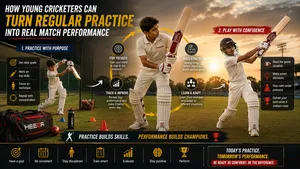 How Young Cricketers Can Turn Regular Practice Into Real Match Performance.Learn how young cricketers can turn regular practice into match performance through realistic drills, match simulations, decision-making, pressure training, and consistency.