Wicketkeeping Gloves Explained: How Size, Palm Design & Flexibility Affect Keeping
Introduction: Why Wicketkeeping Gloves Matter More Than You Think
Wicketkeeping is one of the most demanding positions in cricket. A wicketkeeper may handle hundreds of deliveries during a match, often from different angles, speeds, and bounce conditions. Every ball requires quick hands, good positioning, soft hands, and reliable control.
That is why wicketkeeping gloves are not simply another piece of cricket equipment. They are the main connection between the keeper and the ball.
A good pair of wicketkeeping gloves should help the keeper receive the ball cleanly, absorb impact, maintain control, and move the hands naturally. The wrong gloves can do the opposite. Gloves that are too large may feel slow and difficult to control, while gloves that are too tight can restrict movement and become uncomfortable during a long innings.
Among the most important factors are size, palm design, flexibility, grip, webbing, padding, and overall fit.
But how do these features actually affect wicketkeeping?
This guide explains the important parts of wicketkeeping gloves and how to choose a pair that suits your age, playing level, style, and keeping requirements.
What Are Wicketkeeping Gloves?
Wicketkeeping gloves are specially designed gloves worn by the wicketkeeper to catch, stop, and control cricket balls behind the stumps.
They are different from batting gloves. Batting gloves are designed mainly to protect the hands while holding a bat, whereas wicketkeeping gloves are designed around:
- Ball reception
- Catching control
- Finger movement
- Palm grip
- Impact absorption
- Quick hand movement
- Comfort behind the stumps
Wicketkeeping gloves generally have larger catching surfaces and specific palm and finger designs that help the keeper collect the ball.
The gloves need to provide protection without making the hands feel heavy or restricted.
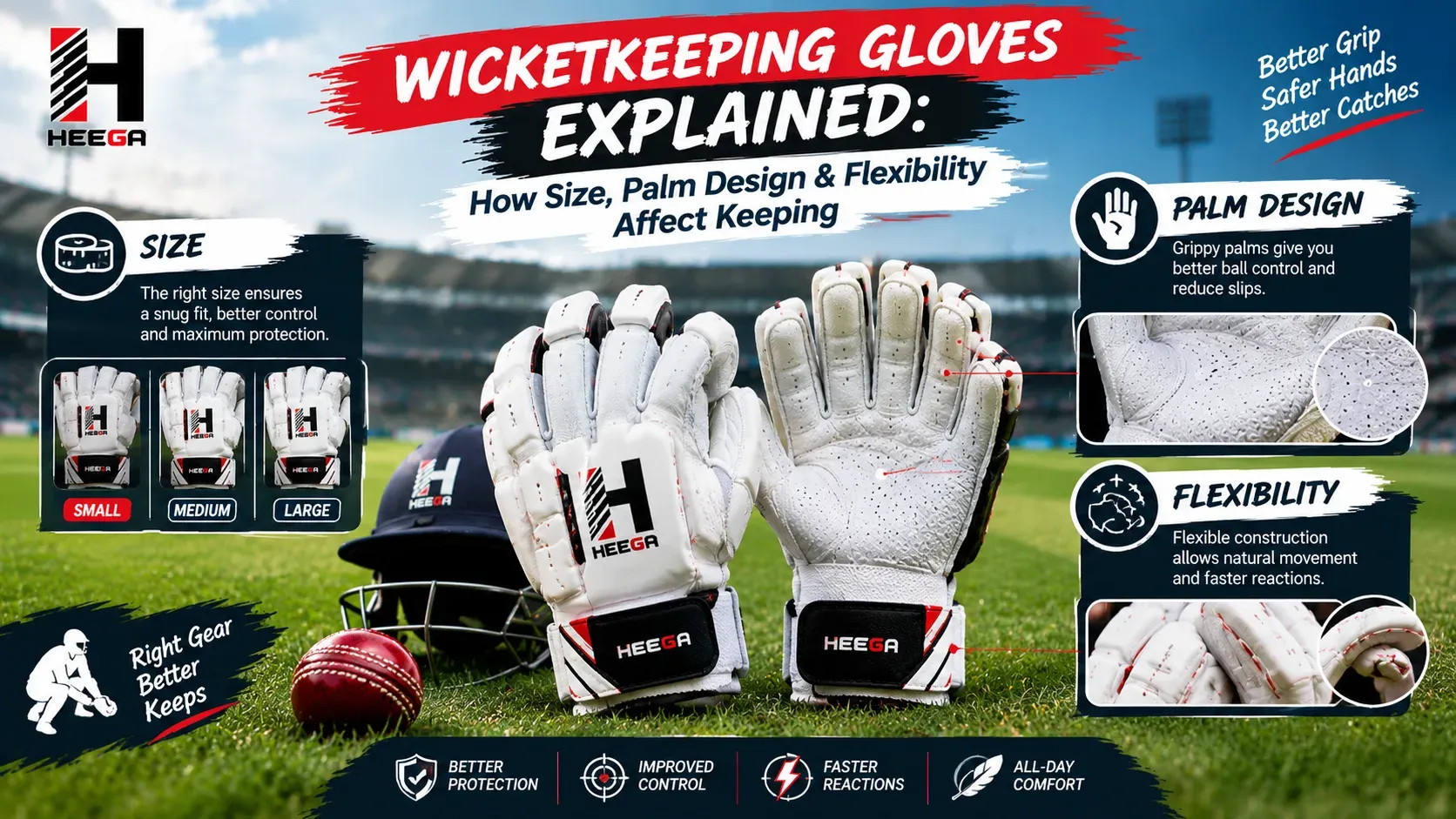
Why Glove Size Is So Important
One of the first things a wicketkeeper should consider is glove size.
The glove should fit the hand properly rather than simply being chosen according to age or appearance.
A correctly sized glove allows the fingers and thumb to move naturally while keeping the catching area in the right position.
If the gloves are too large, the keeper may experience:
- Reduced finger control
- Delayed hand movement
- Loose material inside the glove
- Difficulty closing the glove around the ball
- Less confidence when taking fast deliveries
If the gloves are too small, they may cause:
- Restricted finger movement
- Pressure on the fingertips
- Reduced comfort
- Difficulty opening and closing the glove
- Faster hand fatigue
The goal is to find a balance between room for natural movement and a secure fit.
How to Choose the Right Wicketkeeping Glove Size
Wicketkeeping gloves are commonly available in different sizes for junior, youth, and adult players.
However, age alone should not determine the correct size.
Hand size, finger length, palm width, and the player's overall comfort are more useful indicators.
When trying on wicketkeeping gloves, check the following:
1. Finger Position
Your fingers should sit comfortably inside the glove without being forced against the ends.
2. Thumb Movement
The thumb should be able to move naturally and help control the catching area.
3. Palm Fit
The palm should sit securely against the glove without excessive loose material.
4. Wrist Fit
The wrist closure should keep the glove secure without feeling unnecessarily tight.
5. Closing Action
Open and close the glove several times. It should feel natural rather than stiff or difficult.
A good fit should make you forget that you are wearing the gloves.
Understanding the Palm Design of Wicketkeeping Gloves
The palm is one of the most important parts of a wicketkeeping glove.
It is the area that makes direct contact with the ball, so its shape, material, cushioning, and surface design can significantly affect how the glove feels when receiving a delivery.
A well-designed palm should help the keeper:
- Receive the ball securely
- Control rebounds
- Maintain a stable catching position
- Cushion impact
- Develop confidence when taking difficult catches
Palm design is particularly important because wicketkeepers deal with different types of deliveries throughout an innings.
A ball may arrive slowly from a spinner, quickly from a fast bowler, or unexpectedly after taking an edge.
The glove needs to respond naturally in all these situations.
Palm Shape and the Catching Pocket
The catching area of a wicketkeeping glove should create a natural pocket for receiving the ball.
This pocket helps the keeper absorb the ball rather than allowing it to bounce straight back out.
The shape of the glove affects how easily the keeper can position the hands around the ball.
A useful catching pocket should feel:
- Natural
- Stable
- Easy to close
- Supportive without being rigid
The keeper should still be able to move the fingers and thumb independently.
A glove that feels excessively stiff may make soft catching more difficult, especially when receiving slower deliveries.
Palm Material and Grip
Palm material also influences the way a wicketkeeper interacts with the ball.
A good palm should provide enough grip to help secure the ball while still allowing controlled movement.
Grip becomes particularly useful when:
- Taking edges
- Collecting fast deliveries
- Standing up to the stumps
- Taking catches from spin
- Handling a wet or slightly damp ball
However, grip should not be confused with simply having a very sticky surface.
The keeper still needs to control the ball with proper hand technique.
Gloves can support good technique, but they cannot replace it.
How Flexibility Affects Wicketkeeping Performance
Flexibility is another major factor in wicketkeeping gloves.
A wicketkeeper constantly opens and closes the hands. The gloves therefore need to allow enough movement for the keeper to react quickly.
Flexible gloves can help with:
- Faster hand movement
- Easier glove closure
- Natural catching technique
- Better finger control
- Comfortable movement during long innings
This is especially useful when the keeper has to react to edges or deflections.
Too Much Flexibility Can Also Be a Problem
Flexibility is useful, but a glove should not feel completely unsupported.
If a glove has very little structure, it may not provide the stability or protection required for repeated impact.
The ideal balance depends on the player.
A younger player may prefer a little more structure and cushioning, while an experienced keeper may prefer a glove that allows quicker and more precise hand movement.
The best wicketkeeping glove is not necessarily the stiffest or softest one.
It is the one that provides the right combination of:
Flexibility + support + control + comfort.
Wicketkeeping Gloves and Hand Speed
Behind the stumps, reactions happen in fractions of a second.
A slight delay in hand movement can make the difference between a clean catch and a missed opportunity.
Gloves that fit correctly and allow natural movement can help the keeper react more efficiently.
This is particularly important against fast bowlers.
When standing close to the stumps, the keeper has very little time to respond to:
- Edges
- Inside edges
- Deflections
- Late movement
- Uneven bounce
A well-fitting glove should move with the hand rather than fighting against it.
Standing Back vs Standing Up: Do Gloves Need to Feel Different?
The basic glove requirements remain the same, but the demands can change depending on the keeper's position.
Standing Back
When standing back to fast bowlers, the keeper may face higher ball speeds and more powerful impacts.
Comfortable cushioning and a secure catching pocket become particularly important.
The glove should help absorb the ball without making the hand feel excessively bulky.
Standing Up
When standing up to the stumps, quick hand movement becomes even more important.
The keeper needs to collect the ball rapidly and may also need to react to edges and deflections.
In this situation, flexibility and finger control become particularly valuable.
Wicketkeeping Against Fast Bowlers
Fast bowling places significant demands on wicketkeeping gloves.
The ball can arrive at high speed, leaving very little reaction time.
For fast bowling, look for gloves with:
- Secure fit
- Good palm cushioning
- Reliable catching pocket
- Adequate finger protection
- Comfortable wrist support
- Controlled flexibility
The glove should absorb the impact without making the keeper feel disconnected from the ball.
Wicketkeeping Against Spin Bowling
Spin bowling creates a different set of challenges.
The ball may bounce unpredictably, turn sharply, or arrive at different heights.
The keeper often needs to make quick adjustments with the hands.
For spin bowling, flexibility and ball control are particularly useful.
A comfortable glove allows the keeper to:
- Move the hands quickly
- Adjust to changing bounce
- Collect the ball close to the ground
- React to edges
- Make rapid glove-to-glove movements
Finger Protection and Structural Support
Wicketkeeping gloves also need to provide suitable protection for the fingers.
The fingers can be exposed when receiving fast deliveries, especially when the ball strikes the glove awkwardly.
Protective structures may provide additional support around vulnerable areas.
However, too much rigid protection can affect flexibility.
This is why glove design is often a balance between:
Protection and movement.
For younger players and beginners, protection may be a higher priority.
Experienced keepers may place greater emphasis on mobility and feel.
The Importance of the Thumb
The thumb plays a major role in controlling the glove.
It helps create the catching shape and contributes to stability when receiving the ball.
A well-fitting thumb section should allow:
- Natural movement
- Comfortable closing
- Stable catching
- Good control of the glove
If the thumb area is too tight, the keeper may struggle to close the glove naturally.
If it is too loose, the glove can feel unstable.
Webbing and Catching Control
The webbing area between the thumb and fingers contributes to the overall catching structure.
A good webbing design can help create a reliable catching pocket and support the shape of the glove.
This becomes useful when taking:
- Edges
- Low catches
- Fast deliveries
- Spin catches
- Deflections
The webbing should complement the palm and finger design rather than making the glove feel rigid.
Wrist Closure and Glove Stability
A good wicketkeeping glove should remain secure throughout the innings.
That is where the wrist closure becomes important.
A reliable wrist closure helps prevent unnecessary movement between the glove and hand.
The keeper should be able to adjust the closure so that the glove feels secure without restricting circulation or movement.
A glove that constantly shifts can become distracting, particularly during long spells of keeping.
Lightweight vs Heavier Wicketkeeping Gloves
Weight may not seem like a major consideration, but it can influence comfort over a long innings.
Lighter gloves can feel:
- Faster
- More natural
- Easier to move
- Less tiring
Heavier gloves may offer a greater feeling of structure or cushioning, depending on their design.
The right choice depends on the player's priorities.
For an experienced keeper who values quick hand movement, a lighter-feeling glove may be attractive.
For a beginner, additional structure and protection may provide greater confidence.
Wicketkeeping Gloves for Beginners
Beginners should avoid choosing gloves based only on appearance or price.
At the early stage, the most important factors are:
- Correct size
- Comfortable fit
- Good catching pocket
- Suitable flexibility
- Reliable palm grip
- Adequate protection
- Easy hand movement
A beginner should be able to open and close the gloves comfortably.
If the gloves feel awkward during basic catching drills, they are unlikely to become comfortable during a full match.
Wicketkeeping Gloves for Club Players
Club cricket places varied demands on wicketkeepers.
A player may keep against fast bowlers, medium pacers, and spinners during the same match.
Club-level gloves should therefore offer a balanced combination of:
- Durability
- Comfort
- Flexibility
- Grip
- Protection
- Stable fit
For regular players, investing in a quality pair can make sense because the gloves are exposed to repeated use throughout the season.
Wicketkeeping Gloves for Advanced and Professional Players
Experienced keepers usually have a clearer understanding of their preferred glove characteristics.
They may have specific preferences for:
- Palm shape
- Pocket depth
- Finger flexibility
- Glove weight
- Webbing
- Wrist fit
- Ball feel
At this level, small differences can become noticeable because the player has developed refined hand technique.
The best glove is often the one that matches the keeper's established style rather than simply being the most expensive option.
How Climate and Playing Conditions Affect Gloves
Weather can also influence wicketkeeping gloves.
In hot conditions, sweat can affect comfort and grip.
In humid conditions, moisture management becomes important.
Wet conditions can make ball control more difficult, making reliable palm performance particularly valuable.
After playing in damp conditions, gloves should be dried properly before storage.
Avoid leaving wet gloves inside a closed kit bag for long periods.
How to Break In New Wicketkeeping Gloves
New wicketkeeping gloves may initially feel firmer than a well-used pair.
A gradual break-in period can help the gloves become more comfortable.
Start with simple catching drills:
- Open and close the gloves repeatedly.
- Practice receiving soft throws.
- Perform basic glove-to-glove catches.
- Gradually introduce faster deliveries.
- Work on low catches and edges.
- Use the gloves regularly before an important match.
The aim is to develop a natural catching pocket without unnecessarily damaging the glove.
Wicketkeeping Gloves Maintenance Tips
Proper maintenance can help extend the useful life of wicketkeeping gloves.
Keep Them Dry
After training or a match, allow the gloves to dry naturally.
Avoid Excessive Heat
Do not place the gloves directly against strong heat sources to speed up drying.
Remove Dirt Carefully
Clean surface dirt gently rather than aggressively scrubbing the palm.
Store Them Properly
Keep the gloves in a ventilated part of your kit bag or storage area.
Don't Crush the Palm
Avoid placing heavy equipment on top of the gloves.
A good palm shape is valuable, so protecting that structure helps maintain consistent performance.
Common Mistakes When Buying Wicketkeeping Gloves
Many players make their choice based on appearance, brand, or price alone.
Here are some common mistakes to avoid.
Choosing the Wrong Size
A glove that is too large or too small can affect control.
Ignoring Flexibility
A glove may look well protected but still feel uncomfortable if it restricts hand movement.
Buying Only for Maximum Padding
More padding does not automatically mean better performance.
Ignoring the Palm
The palm is one of the most important areas of the glove and should be evaluated carefully.
Not Testing the Closing Action
Always open and close the glove before making a final decision.
Forgetting Your Playing Style
A glove suitable for a beginner may not suit an experienced keeper.
Wicketkeeping Gloves Comparison Guide
FeatureBeginnerClub PlayerAdvanced Player
Size
Easy, comfortable fit
Secure and precise
Highly precise
Palm
Balanced cushioning
Grip + durability
Feel + control
Flexibility
Moderate
Balanced
Player-specific
Protection
High priority
Balanced
Targeted
Weight
Comfortable
Moderate
Often lightweight feel
Fit
Simple and secure
Stable
Highly customized
Main Focus
Confidence
Consistency
Performance
How to Test Wicketkeeping Gloves Before Buying
Before purchasing a pair, spend a few minutes testing them.
Step 1: Put Both Gloves On
Never judge the fit using only one hand.
Step 2: Open and Close Your Hands
Check whether the gloves follow your natural movement.
Step 3: Check the Fingers
Make sure your fingers are comfortably positioned.
Step 4: Test the Thumb
Move your thumb through its full range.
Step 5: Check the Palm
Look for a comfortable catching pocket and appropriate palm structure.
Step 6: Test a Few Catches
If possible, catch a few balls at different speeds.
Step 7: Check the Wrist
The closure should hold the glove securely without becoming uncomfortable.
This simple process can prevent many buying mistakes.
How Good Wicketkeeping Gloves Build Confidence
Equipment cannot replace technique, but the right gloves can improve a player's confidence.
When a keeper trusts the gloves, they can concentrate more on:
- Watching the ball
- Maintaining their stance
- Moving with the delivery
- Reading the bounce
- Reacting to edges
- Completing the catch
Confidence is particularly important behind the stumps because hesitation can result in missed chances.
The glove should feel like an extension of the hand rather than something the keeper has to constantly adjust.
When Should You Replace Wicketkeeping Gloves?
No glove lasts forever.
You may need to consider replacement when you notice:
- Excessive palm wear
- Damaged stitching
- Loss of shape
- Reduced cushioning
- Loose or damaged webbing
- Poor wrist closure
- Reduced grip
- Uncomfortable fit
If the glove no longer provides the level of control and protection you need, replacing it can be more beneficial than continuing to use a heavily worn pair.
Wicketkeeping Glove Buying Checklist
Before buying your next pair, consider these questions:
- Is the size correct?
- Do the fingers fit comfortably?
- Can I move my thumb naturally?
- Does the glove close easily?
- Does the palm create a comfortable catching pocket?
- Is the flexibility suitable for my style?
- Does the glove provide enough protection?
- Is the wrist closure secure?
- Does the glove feel comfortable after repeated movement?
- Is it suitable for my playing level?
- Will it work well in my normal playing conditions?
If the answer is yes to most of these questions, you are likely moving toward a suitable choice.
Why Choosing the Right Wicketkeeping Gloves Matters
Wicketkeeping is a position where small details can have a noticeable effect.
The size of the glove affects how naturally it fits the hand.
The palm design influences catching and ball control.
Flexibility affects movement.
The webbing contributes to the catching pocket.
Protection helps the keeper handle repeated impact.
And the overall fit determines whether all these features work together comfortably.
That is why choosing wicketkeeping gloves should be about more than selecting a particular colour or design.
The best pair is the one that matches your hands, your technique, and the demands of your game.
Heega Sports: Cricket Gear Designed for Real Players
At Heega Sports, we understand that cricket equipment needs to perform on the field, not just look good in a product photograph.
Whether you are starting your wicketkeeping journey, playing regular club cricket, or competing at a higher level, choosing equipment that provides the right combination of comfort, protection, durability, and performance can make a real difference.
When selecting wicketkeeping gloves, focus on the features that matter most to your game: fit, palm design, flexibility, protection, and control.
Explore cricket equipment from Heega Sports and build your kit around the way you actually play.
Frequently Asked Questions About Wicketkeeping Gloves
1. How should wicketkeeping gloves fit?
Wicketkeeping gloves should fit securely while allowing the fingers and thumb to move naturally. They should not feel excessively tight or loose.
2. Why is palm design important in wicketkeeping gloves?
The palm affects how the ball is received, cushioned, and controlled. A well-designed palm can help create a stable catching pocket.
3. Should wicketkeeping gloves be flexible?
Yes. Enough flexibility is important for quick hand movement and natural glove closure. However, the gloves should still provide adequate structure and protection.
4. Are bigger wicketkeeping gloves better?
Not necessarily. A larger glove may provide more catching surface, but excessive size can reduce hand control and make movement more difficult.
5. What should beginners look for in wicketkeeping gloves?
Beginners should focus on correct size, comfort, flexibility, suitable protection, reliable grip, and an easy-to-control catching pocket.
6. Do fast bowlers require different wicketkeeping gloves?
The basic requirements remain similar, but keepers standing behind fast bowlers may place greater importance on cushioning, protection, secure fit, and impact control.
7. How long do wicketkeeping gloves last?
Lifespan depends on usage, playing conditions, construction, and maintenance. Regular players may need replacement sooner because of repeated wear.
8. Can wicketkeeping gloves improve catching?
Good gloves can support catching through their palm design, pocket, grip, and fit. However, catching technique and practice remain the most important factors.
9. How should I maintain wicketkeeping gloves?
Keep them clean, allow them to dry naturally, avoid excessive heat, protect the palm from crushing, and store them in a ventilated place.
10. Should I choose gloves based on price?
Price can be a useful consideration, but fit, comfort, palm design, flexibility, protection, and durability should be considered before price alone.
Final Thoughts
Wicketkeeping gloves are an important part of a keeper's equipment because they directly influence how the hands interact with the ball.
The right size helps maintain control. A well-designed palm supports catching. Proper flexibility allows quick reactions. Good protection helps the keeper handle repeated impact, while a secure wrist fit keeps everything stable.
There is no single pair of gloves that is perfect for every wicketkeeper.
A beginner may value comfort and protection. A club player may want a balanced combination of durability and control. An experienced keeper may have very specific preferences for flexibility, palm shape, and ball feel.
The key is to choose gloves that work with your hands and your technique.
When the fit feels natural and the glove responds to your movements, you can spend less time thinking about your equipment and more time focusing on the ball.
Shop Cricket Equipment at Heega Sports
Looking for reliable cricket equipment for training, club cricket, or competitive matches?
Explore the latest cricket gear at Heega Sports and choose equipment built around comfort, performance, and the demands of real cricket.
Shop Now: www.Heegasports.com
Related posts
 Batting Gloves vs Wicketkeeping Gloves: Understanding the Key Differences in CricketLearn the key differences between batting gloves and wicketkeeping gloves, including protection, grip, flexibility, design, fit, and their role in cricket.
 Wicket Keeping Leg Guards Explained: Fit, Flexibility and Protection for Faster Movement Behind the StumpsDiscover how to choose wicketkeeping leg guards with the right fit, flexibility, and protection for quicker movement, comfortable crouching, and confident keeping.
 Why Batting Gloves Matter: Understanding Protection, Grip, Flexibility & Hand ComfortLearn why batting gloves matter for protection, grip, flexibility and comfort, plus how to choose the right cricket batting gloves for your playing level.